Chapter 2 of 8
Framing a systematic review research question with PICO
3 min read · Updated
In short
Key takeaways
- PICO (Population, Intervention, Comparison, Outcome) is the standard framework for quantitative clinical review questions.
- Alternative frameworks fit other review types: SPIDER for qualitative and mixed methods, PEO for exposures and experiences, SPICE for social sciences.
- The question framework also supplies your search concepts and later your inclusion and exclusion criteria, so framework choice is a methodological decision, not a formatting one.
- Plan for at least three reviewers: two screening and extracting independently, and a third to adjudicate disagreements.
- When screening and extraction are done by a single reviewer, the work is usually called a rapid review and is considered less methodologically rigorous than dual independent review with adjudication.
Why the research question comes first
The AIPRA workflow begins with formulating the research question: the step where you, as the domain expert, define what the systematic process is meant to answer. A strong question is specific, answerable, and scoped tightly enough to drive search, screening, and synthesis.
In practice, that means anchoring the question in a recognized framework. For quantitative, clinical reviews, PICO (Population, Intervention, Comparison, Outcome) is the usual standard. Other common frameworks include SPIDER (qualitative and mixed methods), PEO (exposure and experiences), and SPICE (social sciences). Each framework helps you define scope, search terms, and later inclusion criteria in a structured way.
AIPRA takes the idea you write in plain language and helps formulate a research question aligned with one of these frameworks, chosen to fit your field and review type.
Building your team
Several stages of a systematic review are designed for independent assessment by more than one reviewer, with a third person to resolve disagreements. For a conventional, high-quality systematic review, teams often plan for at least three people with relevant expertise.
Screening is a typical example: two reviewers each assess records independently; when they disagree on including or excluding an article, a third reviewer adjudicates. Data extraction from full text often follows the same pattern—parallel extraction and conflict resolution—so conclusions stay traceable and defensible.
AIPRA supports this by letting you invite collaborators by email or by sharing an invitation link, so reviewers can join the project with clear roles.
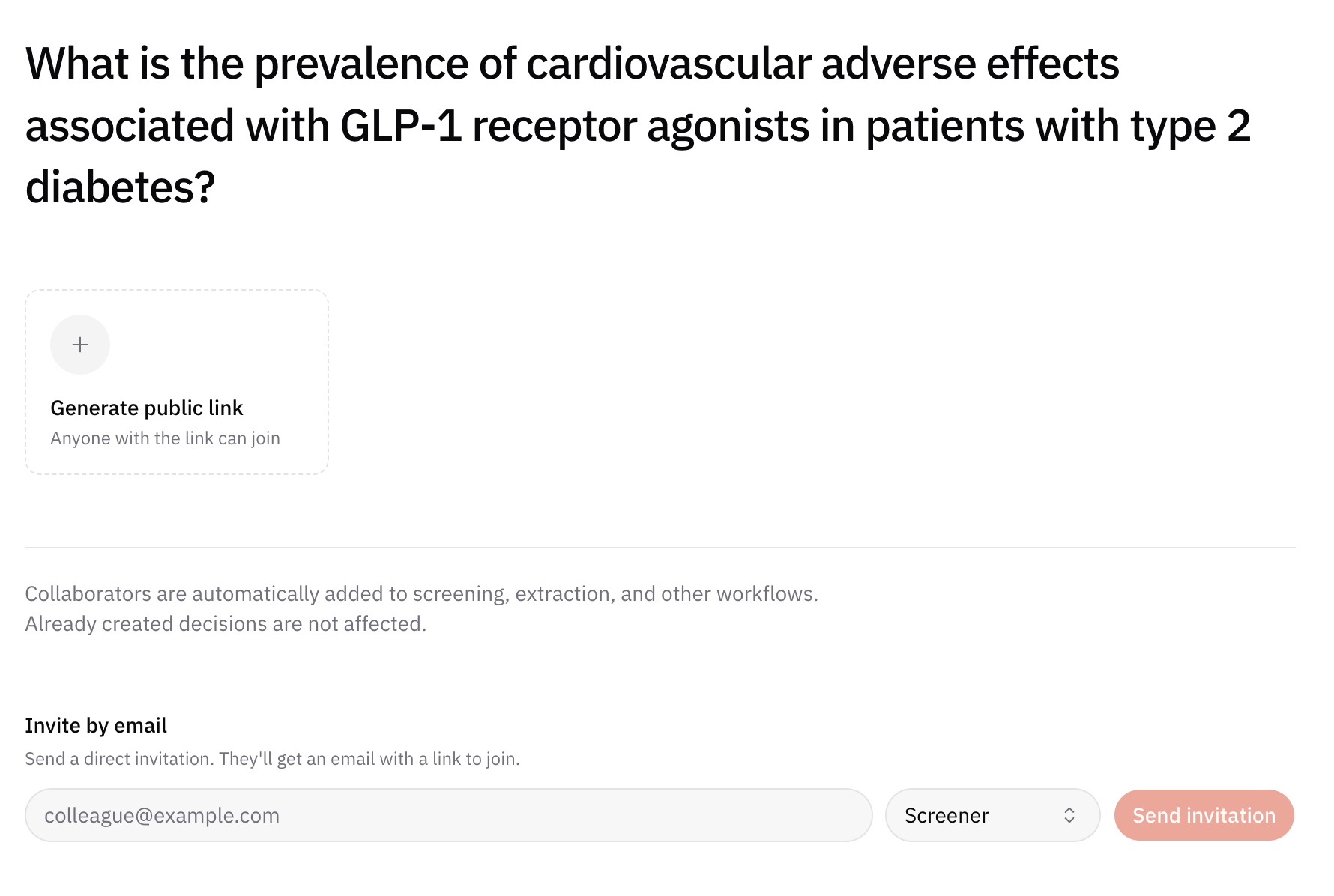
Rapid reviews: When screening and extraction are carried out by a single expert, the work is often described as a rapid review. That approach can be appropriate for time-critical decisions, but it is generally considered less methodologically rigorous than independent dual review with adjudication.
Frequently asked questions
What is the PICO framework?
PICO stands for Population, Intervention, Comparison, and Outcome. It is the most widely used structure for framing quantitative clinical systematic review questions, because each element maps directly onto search concepts and onto eligibility criteria used during screening.
When should I use SPIDER instead of PICO?
SPIDER is generally preferred for qualitative and mixed-methods reviews, where an intervention and comparator may not exist in the way PICO assumes. PEO suits reviews about exposures and experiences, and SPICE is common in the social sciences.
How many reviewers does a systematic review need?
Conventional practice is at least three people with relevant expertise: two who independently screen records and extract data, and a third who resolves conflicts. Independent duplicate assessment with adjudication is what makes screening decisions traceable and defensible.
Is a rapid review the same as a systematic review?
No. A rapid review typically compresses or single-reviews stages such as screening and extraction to deliver results faster. It can be appropriate for time-critical decisions but is generally regarded as less methodologically rigorous than a full systematic review with dual independent review.
How to cite this chapter
AIPRA. Framing a systematic review research question with PICO. In: The Systematic Review E-book. Updated 2026-09-05.
A plain-text version of this chapter is available at /systematic-review-ebook/research-question.md.