Chapter 8 of 8
Writing a systematic review: PRISMA-aligned Methods and Results
4 min read · Updated
In short
Key takeaways
- The manuscript must mirror what you actually did and what you prespecified in the registered protocol; material deviations should be reported with reasons.
- State the registration record (for example PROSPERO) and cite it.
- Report databases, interfaces, and search dates, and provide the full search string for at least one major database so others can reproduce it. Use PRISMA-S for search reporting.
- Name the risk-of-bias tool used (for example RoB 2 for randomized trials) and describe how many reviewers applied it and how disagreements were resolved.
- A PRISMA flow diagram is expected in most systematic reviews and must account for every record from identification through deduplication, screening, full-text decisions, and final inclusion.
- If pooling was not appropriate, follow SWiM so the narrative synthesis remains structured and auditable.
- Current expectations emphasize a reproducible audit trail: another team should be able to understand your process from the paper and its supplements alone.
The final major step is writing up the review—turning your protocol, searches, screening decisions, extraction tables, and synthesis plan into clear Methods and Results sections (and, in parallel, Discussion and other front-matter as required by your target venue). The manuscript should mirror what you actually did in AIPRA and what you promised in your registered protocol and evidence synthesis plan.
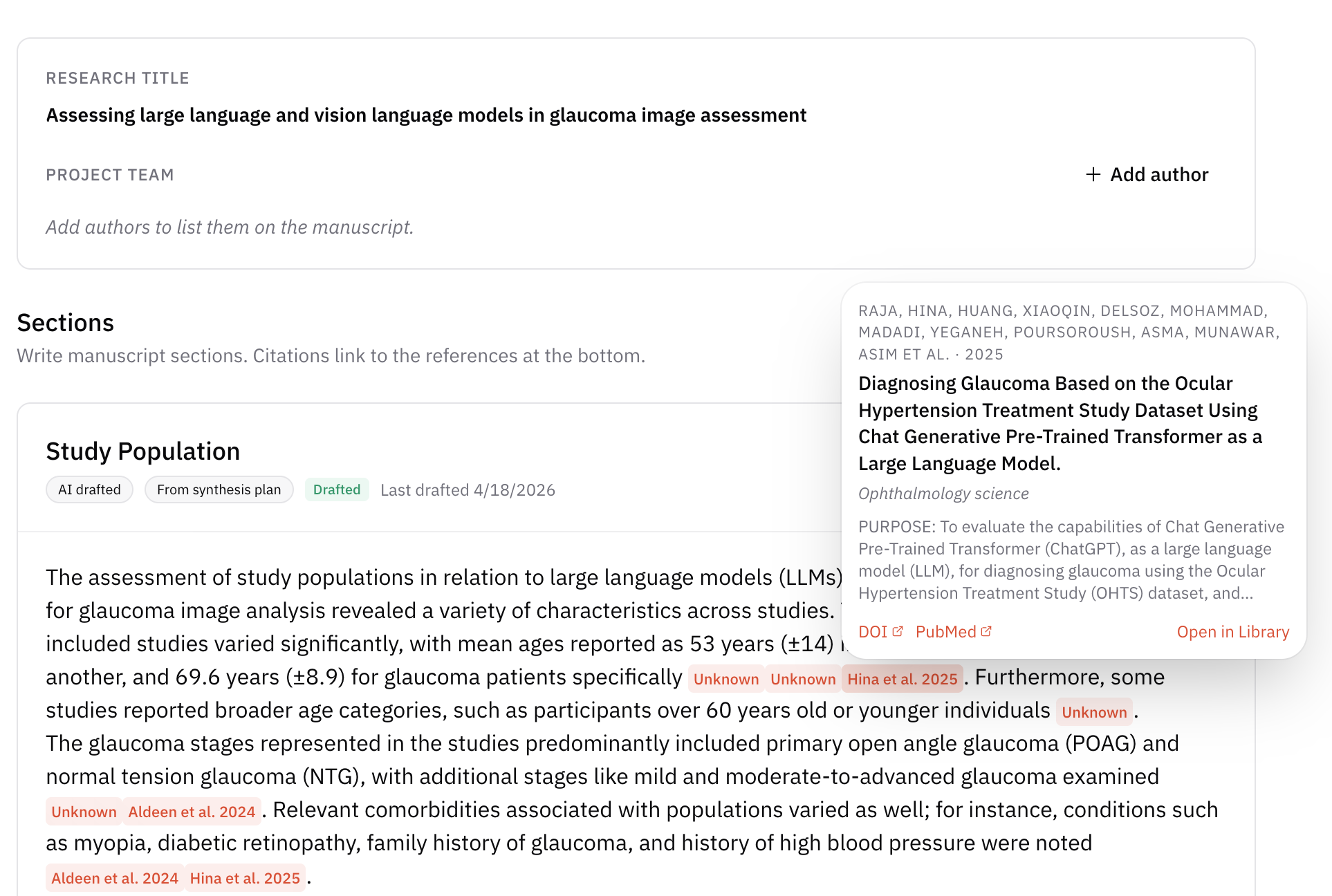
AIPRA can support drafting by generating section text from your project artifacts. When AI-assisted text is offered, the platform emphasizes traceability: claims can be tied back to specific workflow records, extracted fields, or sources so reviewers and readers can verify them—reducing the risk of unsupported statements or hallucinated details.
Writing a systematic review today is as much about transparency as about the numeric results. Expectations for a high-quality review increasingly include a reproducible audit trail: enough detail that another team could understand, and often approximate, your process from the paper and its supplements alone.
Methods — the reproducibility blueprint
A reader with your references and appendices should be able to reconstruct how you found, selected, appraised, and analyzed evidence. The Methods section is that blueprint.
Protocol and registration
State where the review was registered (for example PROSPERO or an equivalent) and cite the record. Describe any material deviations from the published protocol and why they occurred, including changes to eligibility, outcomes, or synthesis that were not prespecified.
Search strategy
Report databases, interfaces, dates, and any grey-literature or supplementary approaches. Current good practice is to provide the full search string for at least one major database in the manuscript or appendix so others can reproduce or adapt it (Page et al., 2021). Structure supplementary search reporting using PRISMA-S (PRISMA-Search) where applicable.
Eligibility criteria
Be explicit about inclusion and exclusion rules—for example language restrictions, date limits, study designs (e.g. “RCTs only”), populations, interventions or exposures, comparators, and outcomes—so they map cleanly onto your screening forms and PRISMA counts.
Quality assessment
Name the risk-of-bias or quality tool (e.g. RoB 2 for randomized trials, Newcastle–Ottawa Scale for some observational designs) and describe how many reviewers applied it, any piloting, and how disagreements were resolved.
Results — transparency through flow
Present results in the same order readers experience the review: from records identified to studies included, then characteristics, then synthesized findings—not only as a flat list of effect estimates.
PRISMA flow diagram
A PRISMA flow diagram is expected in most systematic reviews: it should account for the path of every record from initial search through deduplication, screening stages, full-text decisions, and final inclusion—aligned with the numbers you report in text and tables.
Study characteristics
Summarize included studies in a table keyed to your extraction fields. Use the narrative to highlight patterns, heterogeneity, and outliers rather than restating every row.
Synthesis of results
If you conducted a meta-analysis, report models, heterogeneity, and sensitivity analyses consistent with your analysis plan. If pooling was not appropriate, follow SWiM (Synthesis Without Meta-analysis) so narrative synthesis remains structured and auditable (see also the Evidence synthesis chapter).
Manuscript support in AIPRA
AIPRA’s manuscript workflow is designed to combine collaborative writing with links back to the underlying project data, so drafts stay aligned with extraction outputs and the rest of the review trail.
Frequently asked questions
What must a systematic review Methods section include?
At minimum: the registration record and any protocol deviations; databases, interfaces and search dates with the full search string for at least one database; explicit eligibility criteria; the screening and extraction process including number of reviewers and conflict resolution; the named risk-of-bias tool and how it was applied; and the planned synthesis approach.
What is the current PRISMA reporting standard?
PRISMA 2020 is the current reporting standard for systematic reviews, published by Page and colleagues in 2021. PRISMA-S is the search-reporting extension. A PRISMA-AI extension has been registered with EQUATOR since 2022 but remains under development and is not yet published.
Do I need a PRISMA flow diagram?
Yes, a PRISMA flow diagram is expected in most systematic reviews. It should account for the path of every record from initial search through deduplication, each screening stage, full-text decisions with exclusion reasons, and final inclusion, with counts that reconcile against the text and tables.
Where should I register a systematic review protocol?
PROSPERO is the most widely used prospective register for health-related systematic reviews, though equivalent registries exist for other fields. Register before screening begins and cite the record in the manuscript.
How should AI use be reported in a systematic review?
Report the tool name and version, which stages used AI assistance, the evidence that the tool is methodologically sound for that task, and the human oversight strategy. This follows the 2025 joint position statement on AI in evidence synthesis from Cochrane, the Campbell Collaboration, JBI, and the Collaboration for Environmental Evidence, and the associated RAISE recommendations.
References
- Page MJ, McKenzie JE, Bossuyt PM, et al. The PRISMA 2020 statement: an updated guideline for reporting systematic reviews. BMJ. 2021;372:n71. doi:10.1136/bmj.n71
- Rethlefsen ML, Kirtley S, Waffenschmidt S, et al. PRISMA-S: an extension to the PRISMA statement for reporting literature searches in systematic reviews. Systematic Reviews. 2021;10:39. doi:10.1186/s13643-020-01542-z
- Campbell M, McKenzie JE, Sowden A, et al. Synthesis without meta-analysis (SWiM) in systematic reviews: reporting guideline. BMJ. 2020;368:l6890. doi:10.1136/bmj.l6890
How to cite this chapter
AIPRA. Writing a systematic review: PRISMA-aligned Methods and Results. In: The Systematic Review E-book. Updated 2026-09-05.
A plain-text version of this chapter is available at /systematic-review-ebook/writing.md.