Chapter 3 of 8
Literature search strategy: databases, Boolean queries, and deduplication
6 min read · Updated
In short
Key takeaways
- Search at least two independent bibliographic databases to reduce retrieval bias; in medicine, PubMed is commonly paired with Embase or Web of Science.
- Query construction is a three-step process: identify core concepts, expand each with synonyms, then translate into each database's native syntax.
- Controlled vocabulary differs by platform — MeSH in PubMed, Emtree in Embase — so a query cannot simply be copy-pasted between databases.
- OpenAlex offers broad multidisciplinary coverage and easier programmatic access, and surfaces substantial grey literature such as preprints, which matters for fast-moving fields.
- Deduplication using DOI and PMID catches most duplicate records, but identifier matching is imperfect; plan to resolve residual duplicates during screening.
A core early step is deciding which literature databases to search. That choice should follow the specialty and scope of the review: clinical, methods-focused, multidisciplinary, and emerging fields each lean on different combinations of sources.
In AIPRA, you attach each literature source you plan to search as a database on the project. The interface lists the sources currently available to add and configure for your review.
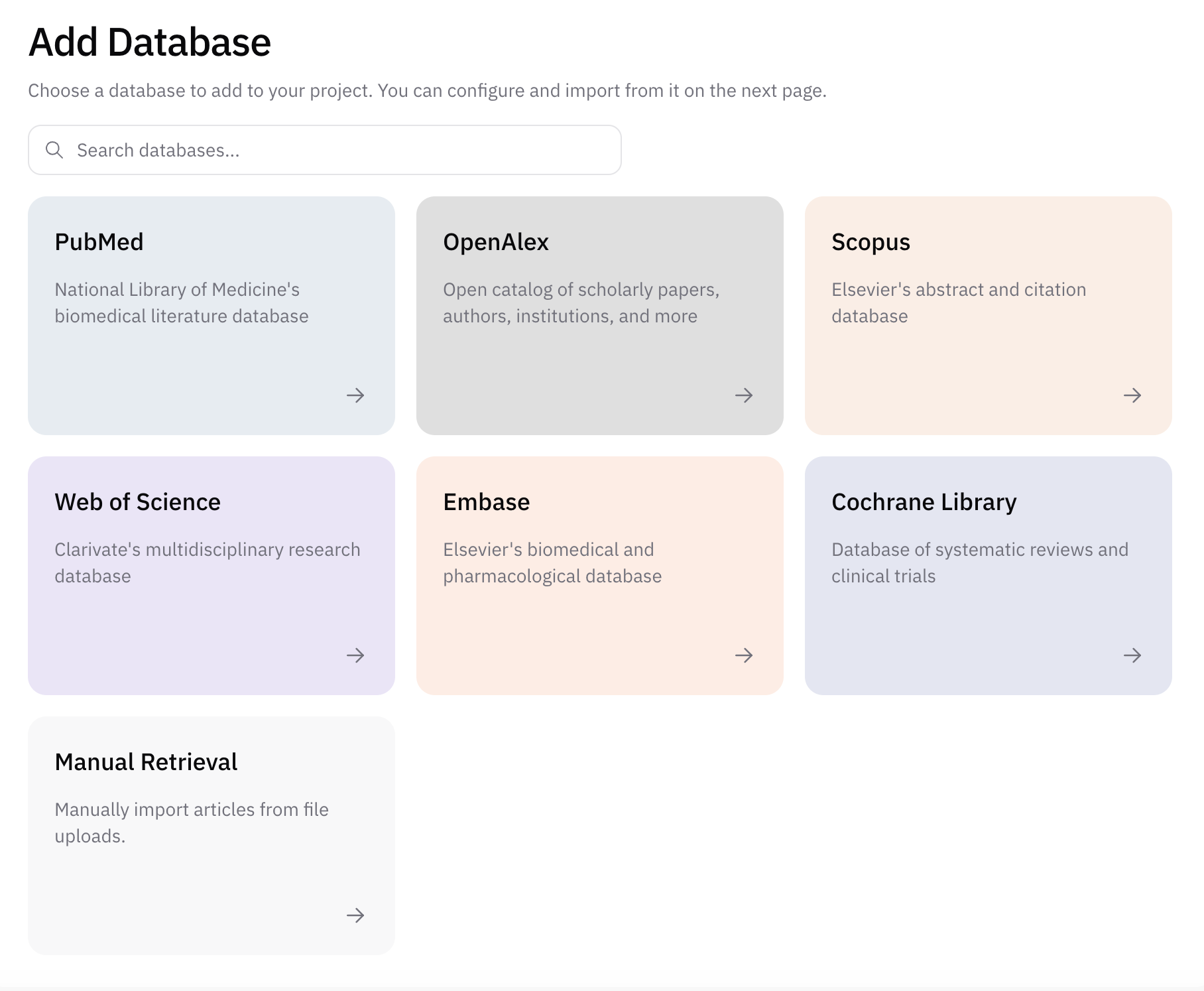
The interactive reference below summarizes six databases teams often consider in the wider literature. Use the pills to jump to a source, or expand a row for full detail on volume, coverage, access, and technical notes.
Common literature databases
Choose a database to see scope, access, and technical notes. Your specialty and question should drive which sources you prioritize; many reviews search at least two independent bibliographic databases.
| Database | Scale | Access | |
|---|---|---|---|
| 37M+ citations | Free / open | ||
| |||
| ~474M works | Free / open | ||
| |||
| 90M+ records | Subscription | ||
| |||
| 170M+ (network) | Tiered | ||
| |||
| 40M+ records | Subscription | ||
| |||
| 9k+ reviews; 2M+ CENTRAL | Free / open | ||
| |||
You can also document and add results from any additional database not listed here when your protocol requires it.
Practical selection guidance
A common recommendation is to include at least two independent bibliographic databases so retrieval bias is reduced. For example, in many medical reviews, teams pair PubMed with Embase or Web of Science (depending on institutional access and the clinical question).
OpenAlex is especially useful when you want broad, multidisciplinary coverage and easier programmatic access. It also surfaces a large share of gray literature—for example preprints that are not yet formally published in a peer-reviewed journal—which can matter for fast-moving topics (such as work on large language models) where delaying until full publication would miss important evidence.
From concepts to a search query
Each database expects searches to be expressed in its own syntax and field rules. That expression is your search query. Building one is usually a multistep process.
- Identify the main concepts implied by the research question. For example, for “The use of AI in diabetic retinopathy screening,” core concepts might be: AI, diabetic retinopathy, and screening.
- Expand each concept with synonyms and related terms that authors might have used in titles, abstracts, or keywords. The goal is sensitivity: retrieve relevant studies even when terminology differs. For the AI concept, examples include: machine learning (ML), automated systems, automation, neural networks, deep learning, natural language processing (NLP), cognitive computing, intelligent agents, computer vision, and knowledge representation—always tailored to what fits your question and database.
- Assemble the database-specific query using those terms, Boolean operators, proximity or phrase rules, and field limits as required by each platform (for example MeSH in PubMed versus Emtree in Embase).
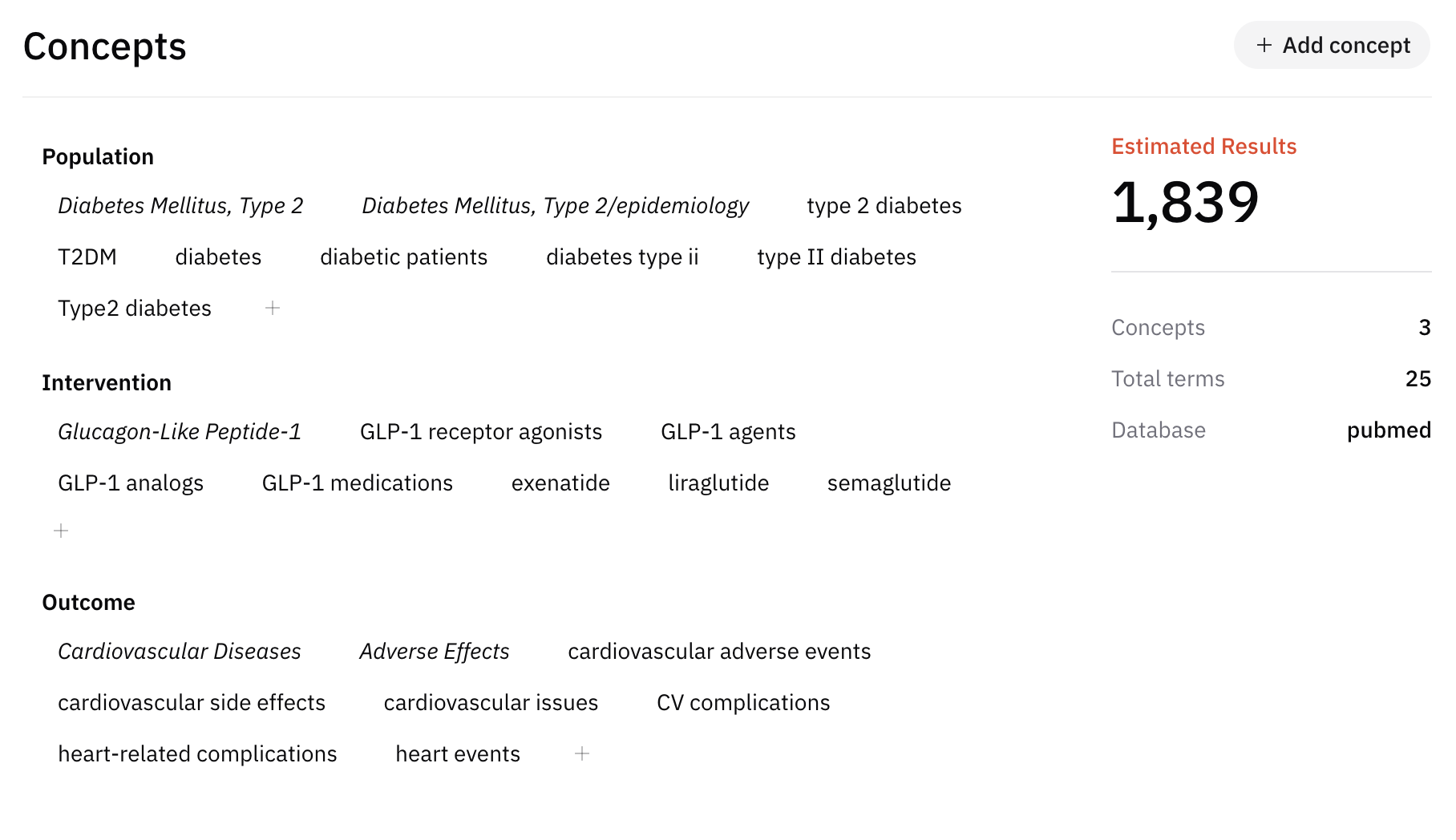
How AIPRA helps
AIPRA can suggest concepts and synonym lists starting from your research question. When you select a database in the workflow, it can also help draft a query aligned with that source’s typical syntax— which you should still validate against the live database and your information specialist’s advice.
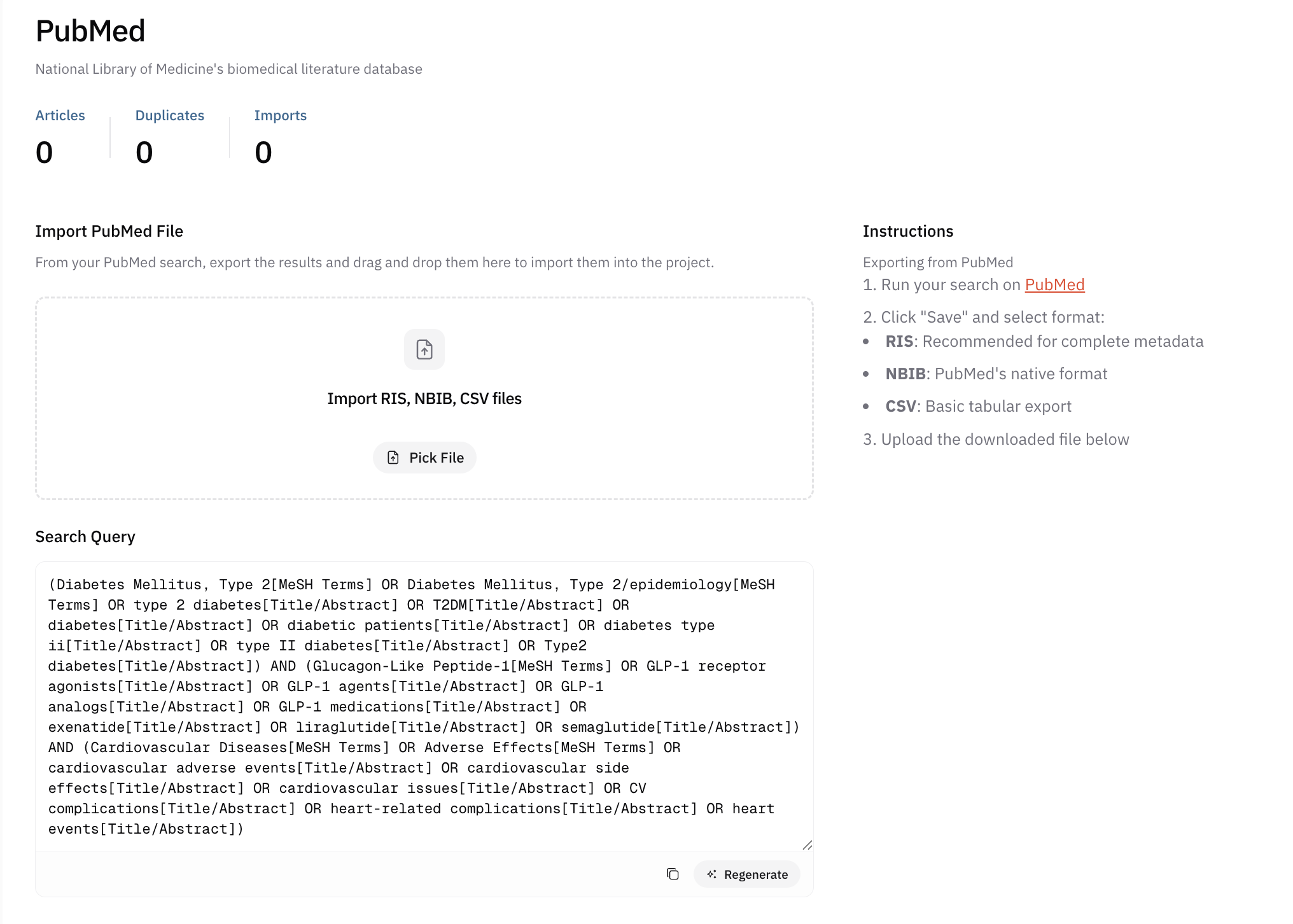
In practice, you will usually run the search yourself in each database’s native interface: open the site, paste or adapt the query copied from AIPRA, run the search, export the records your protocol specifies, and upload those exports into AIPRA’s database area for the project so screening and deduplication stay centralized.
Deduplication across databases
Searching multiple databases almost always retrieves the same article more than once when it is indexed in several places. AIPRA runs a deduplication pass using unique identifiers such as DOI and PMID, which catches most duplicate records automatically.
Identifier-based matching is strong but not perfect; a small number of duplicates may still appear during screening (for example when metadata differs between exports). Teams should plan to resolve those remaining duplicates as part of title/abstract or full-text review.
For methodological context on deduplication in systematic reviews, see the Cochrane Handbook section on deduplication: Cochrane Handbook — duplicate reports and deduplication.
Frequently asked questions
How many databases should a systematic review search?
A common recommendation is at least two independent bibliographic databases, so that indexing gaps in any single source do not bias retrieval. The specific combination should follow the review's specialty and scope, and institutional access often constrains the choice.
How do I build a Boolean search string for a systematic review?
Start by identifying the main concepts in your research question. Expand each concept with synonyms and related terms that authors might have used. Then combine synonyms within a concept using OR, combine concepts using AND, and add field limits and controlled vocabulary appropriate to each database.
Why does my PubMed search not work in Embase?
Each database has its own syntax, field tags, and controlled vocabulary. PubMed uses MeSH terms while Embase uses Emtree, and phrase and proximity operators differ. Queries must be translated per database rather than reused verbatim.
How are duplicate references removed in a systematic review?
Deduplication normally relies on unique identifiers such as DOI and PMID, which resolves the majority of duplicates automatically. Because metadata can differ between exports, a small number of duplicates typically survive and should be removed during title/abstract or full-text screening and reflected in the PRISMA flow diagram.
Should systematic reviews include grey literature?
Including grey literature such as preprints, theses, and reports can reduce publication bias and matters most in fast-moving fields where peer-reviewed publication lags. Sources like OpenAlex surface a large share of preprints. Whether to include grey literature should be prespecified in the protocol.
References
- Cochrane Handbook for Systematic Reviews of Interventions, Chapter 4 (searching for and selecting studies), section on duplicate reports and deduplication. https://www.cochrane.org/authors/handbooks-and-manuals/handbook/current/chapter-04
How to cite this chapter
AIPRA. Literature search strategy: databases, Boolean queries, and deduplication. In: The Systematic Review E-book. Updated 2026-09-05.
A plain-text version of this chapter is available at /systematic-review-ebook/searching-for-articles.md.